
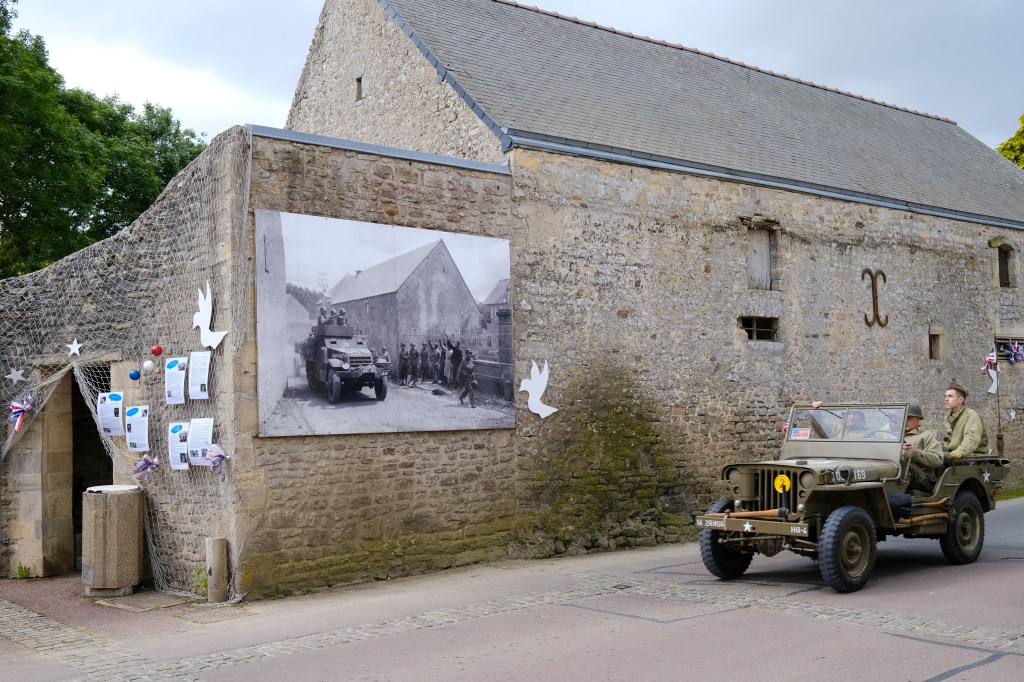
I first visited Normandy in July of 2018. It was mind-blowing visiting the sites etched in my imagination by movies like Saving Private Ryan and games like Medal of Honor. Since my early teens I was an avid learner of World War II, particularly the American participation in the Western Front of Europe. Visiting with my wife that year, I was amazed by how much modern Normandy resembled all the historical photos and video reels I’d seen in books and on the internet. We drove through the narrow country roads of the bocage, passing by the dry stone walls and the infamous hedgerows that troubled American troops in their campaign over seventy years before our visit. It was easy to imagine driving down the very same roads in a Sherman tank or Willys jeep in 1944 – it hadn’t changed much since then. The more modern additions like the many museums dedicated to Le Débarquement scattered around the region along with guided. tours of the landing beaches was more than could be explored in just a week. Our visit made a huge impression to me and I became determined to return for the commemorations for the 80th Anniversary to take place five years later in 2024.
Fast forward to 2024. Four years after the coronavirus pandemic turned the world on its head. We avoided international travel for a couple years only resuming in 2022 and 2023, this time taking our son along. I started toying around with the idea of a family road trip around Normandy during the D-Day commemorations when we got a surprise visit from the stork. We welcomed our baby girl to the world in October of 2023. While we adjusted to our new life as a family of four and the excitement of a new baby in the house, the prospect of a long-haul flight and weeks of travel with a 8-month-old baby in tow didn’t sound great. At my wife’s encouragement, we decided this could be a great opportunity for a father-son trip – our 7-year-old boy loved the idea of an adventure with his dad and I thought it could be a nice chance to bond while sharing my enthusiasm of military history with him.
As the date got closer, I got a little apprehensive as I realized just how big a deal a milestone anniversary year for D-Day commemorations are, such as the 80th. Large sections of Normandy would be closed off to traffic to control the crowds and for security with many heads of state passing through including President Macron and President Biden. Reading about the congestion of the 70th and 75th anniversary commemorations, I wondered if we’d be spending more time fightings crowds than actually being able to soak in the atmosphere of the occasion. Still, to take part in such a momentous occasion, especially when the precious few remaining veterans of that war were still present, was an experience I couldn’t miss out on – especially with my son along for the ride.
We flew from Los Angeles to London where we spent a few days exploring , including the Imperial War Museum and the National Army Museum where we got to meet a survivor of the London Blitz and hear her tell her story. We hopped on a Eurostar train to Belgium for a few more days in Bruges before grabbing a train to Paris where we picked up on our rental car and were bound for Normandy. With the events taking place around the anniversary, hotels were quickly booked and prices were jacked up for what was available. I splurged on a pricey stay in Bayeux for the days around June 6th, but for the days preceding, I took a chance on a random bed and breakfast we found in Gavray, an off-the-path, very rural commune about an hour south of all the D-Day sites.
Around D-Day commemorations, there is a dizzying amount of events, ceremonies, displays taking place around the Manche and Calvados departments of Normandy where the landings and parachute drops took place. I had a hard time figuring an itinerary and decided to not stress it out too much and just wing it. Our first stop was to see a parachute demonstration in a field near Carentan. A road was closed off with large crowds of families and military enthusiasts sitting on the grassy banks waiting for the demonstrations to begin. Many of the spectators were dressed in period type clothing and replica military uniforms. It was funny and a bit charming to see French mothers bringing their teenaged sons dressed in complete replica US Army World War II paratrooper uniforms. There were young couples dressed as French resistance or just French civilians in 1940s period clothing. Among the crowd, there were also lots of active duty military from various countries strolling around – they were to take part in the week’s events, but were doing the tourist thing too in their own time.


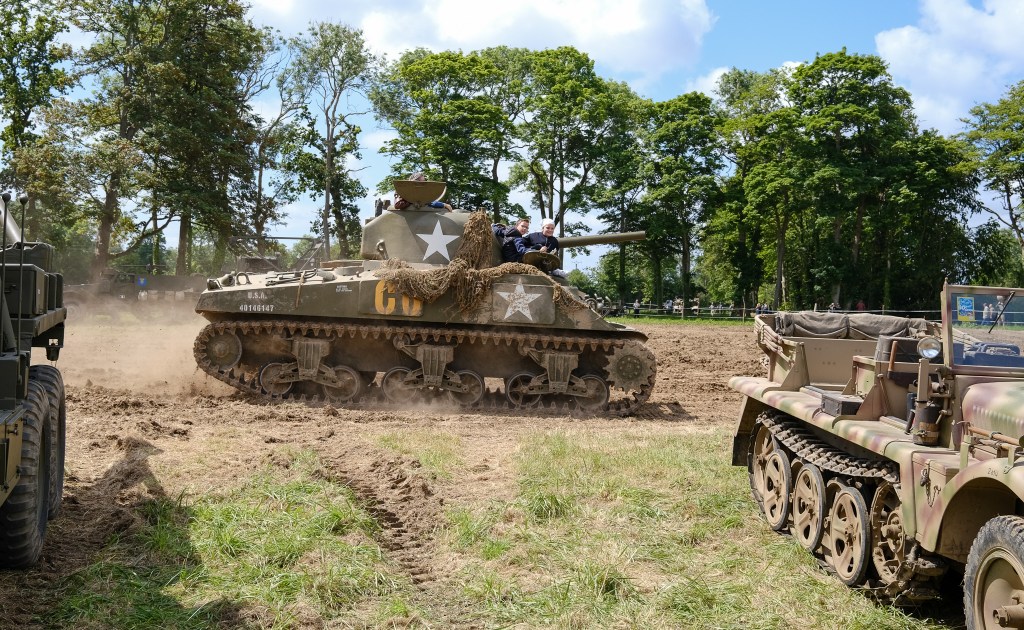
At various locations around Manche and Calvados, mostly outside the major museums, there were reenactment camps set up with various World War II vehicles, jeeps, trucks, ambulances, tanks and so on. Europeans dressed as American GIs or British Tommies set up foxholes, posed with replica firearms, and happily posed for photos. Most of these people were friendly – a small group even offered my kid an M1 helmet to take a photo in front of their military truck with them. It felt a little incongruous to me to see so many WW2 American GIs chattering to each other in French, Dutch, Polish- even German!

I underestimated just how big a factor the military enthusiasts, collectors, and reenactors were at these events. All over the highways in Calvados and Manche there were Willys jeeps, 2 1/2 ton trucks, and other olive drab vehicles of all sorts in convoys, on trailers, and full of passengers in Second World War garb. They came largely from the UK, France, Netherlands, the Balkans, and even many from Germany – some driving German vehicles from the war. While the highways were fine, this posed a major problem on all the tiny, narrow rural roads and sharp corners in the areas between the major points of interest, museums, and reenactment camps. Trying to see as many sites as we could, my son and I found ourselves stuck in gridlock in one particular corner near the Overlord Museum inching forward through a chaotic tangle of recreational campers, military jeeps, 2 1/2 ton trucks and more multiple times throughout the week. While the majority of the vibes were good at the events, there is an odd side to the reenactors. Most were extremely friendly and happy to share their enthusiasm with visitors. With some, there was a cosplay aspect to it.

I realized that for some it was less about commemorating the event as much as their own hobby, and this was a bigger year round subculture than just recognizing the history of a momentous occasion. Later on I would see that there was a lot of resentment from the British reenactors about how ubiquitous American GI reenactors were and the overwhelming amount of American vehicles. They were most offended by the amount of British reenactors they encountered that were dressed as American GIs! Most controversially, they were upset at the presence of American jeeps in the parade that went through Bayeux, a town that was liberated soley by the Brits. I think this is testament to how much Hollywood has done to immortalize the American GI! Still, the reenactors and their displays add a lot to the atmosphere of the commemorations and make for a very unique experience. Aside from the visitors from around Europe and North America, the locals make it a very lively event.
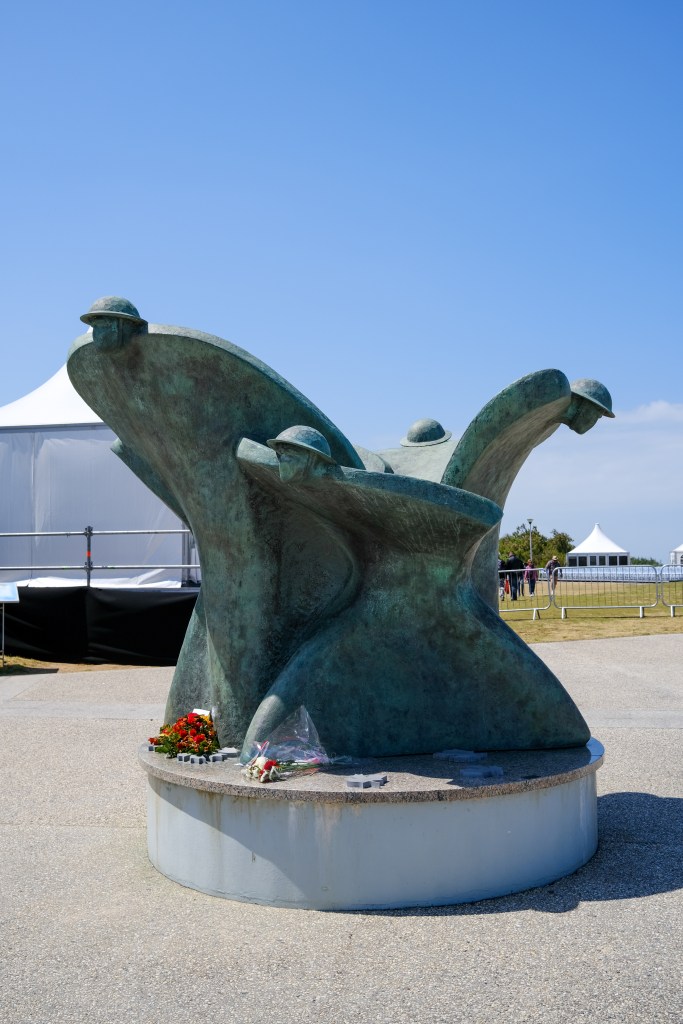
The scale of the 80th anniversary made it difficult to see many of the sites. The Normandy American Cemetery was mostly closed off and packed in preparation for events on June 6th. There seemed to be more development around Omaha and Utah beaches with an eye toward future preservation and controlling foot traffic a bit more. Pointe du Hoc, the famous cliff scaled by Army Rangers, was closed off in anticipation of all the crowds that week. The museums had massive lines, but we were able to squeeze in most of what we wanted to see except for the Airborne Museum. Being my second visit, I was able to see sites I hadn’t previously, such as the Bayeux War Cemetery (Commonwealth), the Canadian landing beach at Juno, and the German War Cemetery in La Cambe. The latter of which was a very sobering experience. The amount of respect shown by the French to the fallen of their former enemy and occupiers was moving. A great symbol of peace and a dedication to cooperation after a bloody century. We also got to see a small contingent of German Bundeswehr do a small ceremony of laying a wreath on a monument dedicated to the German fallen soldiers.
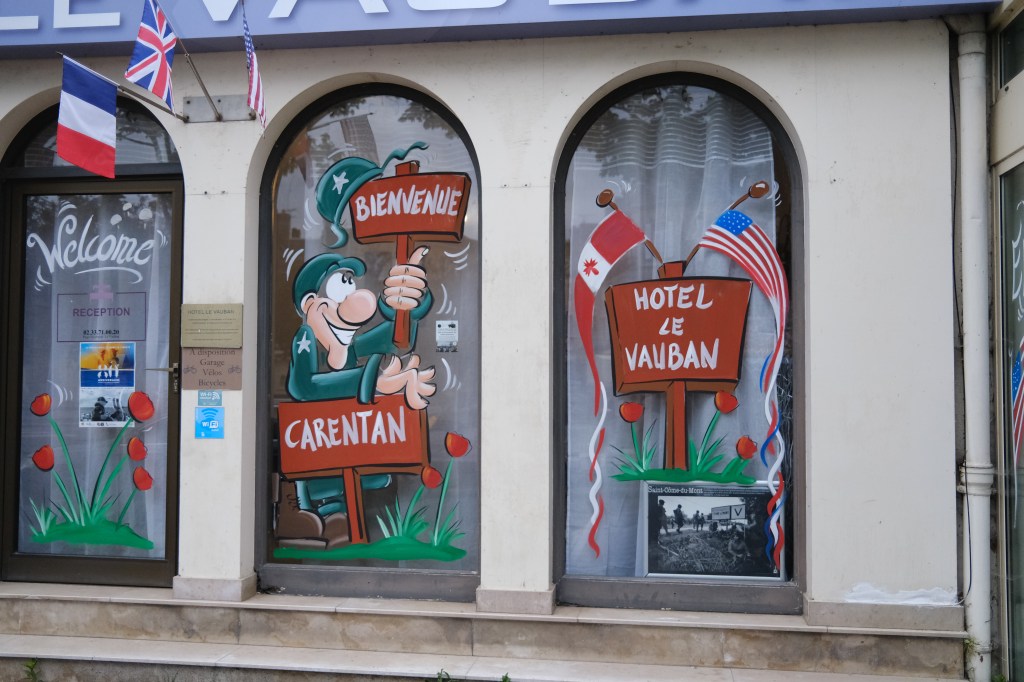
Amid the sometimes carnival atmosphere of cosplay, 40s swing music, cider and saucisse sandwiches, I feel among the Normans a legitimate sense of gratitude to that generation of Americans, Brits, Canadians, and Poles. Yeah, there’s a commercial aspect and tourism draw with all the American and UK flags strewn around, the English menus and painted windows welcoming visitors. For many, it’s an economic boost and a party, for sure. But there were also moments like when I was approached randomly by a French woman excitedly telling me there was an actual World War II veteran nearby shaking hands with people. The aging veterans, pushing 100 years old, were like celebrities there during the commemorations. Being able to see the events with actual veterans of that war and the Normandy campaign present was a major factor in us going.

I’ll never forget outside the Overlord Museum while waiting in a tangle of lines to get beer, cider, and food from various stands – the entire crowd was suddenly turning around. A large tour bus was departing from the parking lot. Inside, there were several World War II veterans and their families, looking outside and waving bye to the crowd. Everyone that stood out there began to applaud out of respect and wave goodbye. That moment alone made it worth going on the 80th Anniversary.
The 81st has now gone and past, and again, I’m committing myself that I need to return next year with my family in tow to visit a special place.

 Dogface History